William McKinley: the record and the legends
The Major. The 25th president, 1897-1901, from Ohio. Every story here is tagged Record, meaning it’s documented, or Legend, meaning it gets told a lot and doesn’t hold up. Each one links to its source.
- President
- 25th
- In office
- 1897-1901
- Home state
- Ohio
- Party
- Republican
- Height
- 5'7"
The record
The legends
What he cared about
- High tariffs to protect American factories, as a congressman and as president.
- The gold standard. He signed the Gold Standard Act in 1900.
- Expanding overseas: Puerto Rico, Guam and the Philippines after the war with Spain, and Hawaii in 1898.
The full record
His push to hold the Philippines led to the Philippine-American War, which cost more than 5,000 American and roughly 200,000 Filipino lives and put the islands under U.S. rule against their independence movement.
How he fights in POTUS KO
Four years in the Union Army, private to major
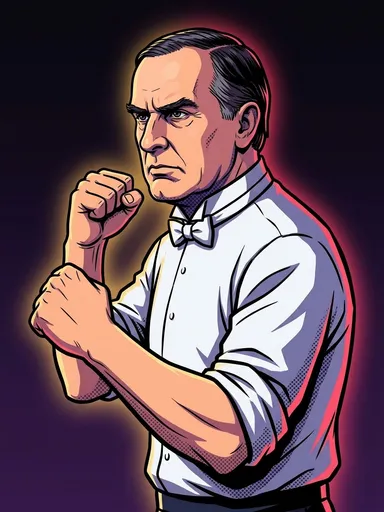
McKinley was patient: he waited out Spain before going to war and made the 1896 campaign come to his porch. In the ring he wrestles on his own ground and lets you come to him.
See POTUS KOQuestions about William McKinley
Was William McKinley a puppet of Mark Hanna?
For decades, historians called McKinley a puppet of his rich campaign manager, Mark Hanna. Newer research flips that. McKinley used Hanna, and he put Theodore Roosevelt on the 1900 ticket over Hanna's objections.
What was McKinley's front porch campaign?
In 1896 McKinley didn't tour the country. He stayed home in Canton, Ohio, and let the country come to him: about 750,000 visitors, and roughly 300 short speeches from his own front porch.
What did William McKinley do at Antietam?
At Antietam in 1862, Sergeant McKinley drove a wagon of hot coffee and food through the middle of the fighting, without orders, and served every man in his regiment. His colonel, future president Rutherford B. Hayes, wrote that McKinley passed under fire and delivered.