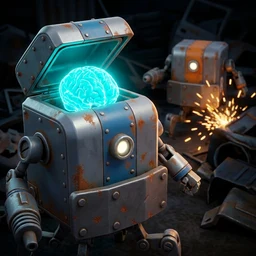
Build a robot.
Teach it to fight.
Bolt it together from scrap. Then give it a brain: a short list of rules it follows on its own. You don't steer it. You watch it think, and then you find out whose robot your friends can't beat.
Coming to iPhone, iPad and Android. Free to play. $1.99 once removes the ads. No subscription.
Three steps, then it's on its own
Build it
Seven bodies, four kinds of legs, and a pile of weapons and sensors. Every part changes how it fights: treads can’t be knocked back, a Dome has no weak back, and a Mech sees further.
Give it a brain
Rules, top to bottom: “if it’s within 1 tile, swing the hammer.” The first rule that fits is what it does. Add AND, OR and NOT when you’re ready.
Watch it fight
Both brains light up under the fight, so you see exactly which rule fired and why. Lost? Change one rule and run it back.
Try one right now
This robot has a Hammer and three rules. It can't beat a dummy that doesn't even move. Can you see why?
- When I can see it → back away
- When it’s within 1 tile → attack with Hammer
- When I can see it → close in
- Otherwise → go looking
Rules run top to bottom, and the first one that fits wins. That’s the first of ten Daily Drills in the game.
Fight your friends’ robots
Every robot packs into a short code: its parts, its level and its whole brain. Text yours to a friend, they paste it in, and the two robots fight on their phone.
Same codes, same fight
The two codes decide everything, so you both watch the exact same fight on your own phones. Then you both go fix your rules.
The family ladder keeps score
Every robot you’ve fought from a code stays on your ladder with your record against it. A new code under the same name updates the bot and keeps the score.
Pick the right robot
Keep up to five builds, like a long-range one and a close-range one, and choose which one faces each friend.
Send the knockout
Every knockout can become a short clip with both robots and the rule that finished it. Send it to anyone, even friends who don’t have the game.
No online play and no chat: codes travel by text or in person, so there’s nothing for a stranger to reach.
For parents: it’s real programming
Every rule your kid writes is an if-then statement. Every fight is a test run. Every loss is debugging. A Daily Drill teaches one idea a day:
- Sequencing
- Conditionals
- Boolean logic: AND, OR, NOT
- Parameters
- Events
- Tracking state
- Simplifying
And when they’re ready, one tap shows their robot’s brain as real Python. Same rules, written the way a programmer would.
# Rustbucket's brain, checked 2.5 times a second
def think(me, enemy):
    if me.health < 30:
        return back_away()
    if distance(enemy) <= 1:
        return attack("Hammer")
    if sees(enemy):
        return keep_away(4)
return go_looking() # otherwise- No subscriptionFree to play. $1.99 once removes the ads, for good.
- Works offlineCars, planes, no Wi-Fi. It never needs the internet.
- No accountNo sign-up, no email, no chat. It collects nothing.
- Made for 10 to 14And built so a 16-year-old isn’t embarrassed playing it.
Questions
What age is it for?
Built for 10 to 14, and made so a 16-year-old won’t be embarrassed playing it. Younger kids can start with the “Build me a brain” helper, which asks three questions and writes the rules for them.
Is it really coding?
Yes. The rules are the same if-then logic every programming language uses, and the game can show them as real Python. It doesn’t teach typing syntax. It teaches thinking like a programmer: order, conditions, and fixing what didn’t work.
How do we fight each other?
Each robot has a code. Send yours by text or read it out, your friend pastes it in, and the fight runs on their phone. The same two codes always give the same fight, so you both see what happened.
Are there ads?
A short one between fights at most, never in the middle of one. $1.99 once removes them.
Does it need the internet?
No. Everything runs on the phone. Robot codes are shared in person or by message.
What data does it collect?
None. No account, no tracking, nothing sent anywhere.