How to play sudoku
Nine short lessons, one idea at a time. Each one explains the idea, walks through an example on a real board, then gives you a board to try it yourself.
1 The one rule
Step 1 of 5
Sudoku is a 9 by 9 grid, split into nine boxes. You fill it with the numbers 1 to 9.
Read every step
- Sudoku is a 9 by 9 grid, split into nine boxes. You fill it with the numbers 1 to 9.
- This is a row. It has 1 to 9, each one exactly once.
- This is a column. Same rule: 1 to 9, once each.
- This is a box, inside the thick lines. Same rule again.
- That's the only rule. Every row, every column and every box gets 1 to 9 once. No repeats.
2 The last gap
Step 1 of 4
The easiest place to start: a row, column or box with only one empty square.
Read every step
- The easiest place to start: a row, column or box with only one empty square.
- Row 5 has eight numbers and one gap.
- Count them off: 1, 2, 4, 5, 6, 7, 8, 9. The one missing is 3.
- So the gap has to be 3. Nothing else is left for it.
3 Rule squares out
Step 1 of 7
This trick finds most of the moves in an easy puzzle. Where can the 5 go in the top-left box?
Read every step
- This trick finds most of the moves in an easy puzzle. Where can the 5 go in the top-left box?
- Start with the 5s you can already see.
- Row 1 already has a 5. A row can't have two, so no other square in row 1 can be 5.
- Row 3 has a 5 too. Rule that row out as well.
- Column 2 has a 5 further down. Rule it out.
- And column 3.
- Only one square in the box is left, so the 5 has to go there. This is called cross-hatching.
4 Only one fits
Step 1 of 6
Sometimes one square is boxed in from every side. Look at the middle square.
Read every step
- Sometimes one square is boxed in from every side. Look at the middle square.
- Its row already has 9, 2, 4 and 5.
- Its column has 7, 1 and 6.
- Its box has 3 and 4.
- Put together, that rules out 1, 2, 3, 4, 5, 6, 7 and 9. Eight numbers.
- Only 8 is left, so the square has to be 8.
5 One find leads to the next
Step 1 of 8
Every number you place is a new clue. One find often leads straight to the next.
Read every step
- Every number you place is a new clue. One find often leads straight to the next.
- Let's find the 5 in the top-left box.
- Because row 1 already has a 5, the box's 5 can't be in row 1.
- Columns 2 and 3 have 5s further down, so rule those out too.
- That leaves two squares, and one of them already has a 7. So the 5 goes in the other one.
- Now that new 5 does some work. Rows 1 and 2 both have a 5, which means the top-middle box has to put its 5 in row 3.
- Columns 4 and 5 already have 5s down below, so it can't go there either.
- So it has to go here. Because of the first 5, we found the second.
6 Two gaps, two numbers
Step 1 of 6
When a row has two gaps left, you can often work out which number goes where.
Read every step
- When a row has two gaps left, you can often work out which number goes where.
- Row 8 has two empty squares.
- The row is missing 7 and 9. So one square is 7 and the other is 9. Write both in small.
- Now look up column 8. It already has a 7, so this square can't be 7.
- Which means it has to be 9.
- And that leaves 7 for the other gap. Two numbers placed from one clue.
7 Pencil marks
Step 1 of 6
Harder puzzles don't hand you a move. That's when you write small notes, called pencil marks.
Read every step
- Harder puzzles don't hand you a move. That's when you write small notes, called pencil marks.
- Take this square. Its row, column and box already use 1, 4, 5, 6, 7 and 9.
- So only 2, 3 and 8 could go here. Write those in small.
- Do the same for every empty square in the box.
- Now look for a number that shows up only once. 8 is only in one square's notes.
- The box still needs its 8, and this is the only square that can take it. So 8 goes there, even though that square had 3 choices.
8 Pairs
Step 1 of 5
Pencil marks let you spot pairs. This board is smaller, 6 by 6, so the idea is easier to see.
Read every step
- Pencil marks let you spot pairs. This board is smaller, 6 by 6, so the idea is easier to see.
- These two squares in box 6 can only be 3 or 4.
- One of them is 3 and the other is 4. We don't know which yet, but between them they use up both.
- So no other square in box 6 can be 3 or 4. Cross those notes out.
- That's called a naked pair: two squares with the same two choices claim both numbers.
9 Pointing pairs
Step 1 of 4
One more pattern with notes. This one points from a box out along a row or column.
Read every step
- One more pattern with notes. This one points from a box out along a row or column.
- In box 2, the 5 can only go in these squares.
- They're all in row 1. So box 2's 5 is somewhere in row 1, we just don't know where.
- Which means no other square in row 1 can be 5. Cross those out. That's a pointing pair.
You're ready
Rule squares out, look for the last gap, check what fits, and follow the chain. That covers any Easy or Medium puzzle. Hard and Expert use a few more tricks, and the hint names each one when you need it.
Start today's puzzleTeaching a younger kid? The kids board uses animals on smaller grids. Kids sudoku
More free puzzles
See them all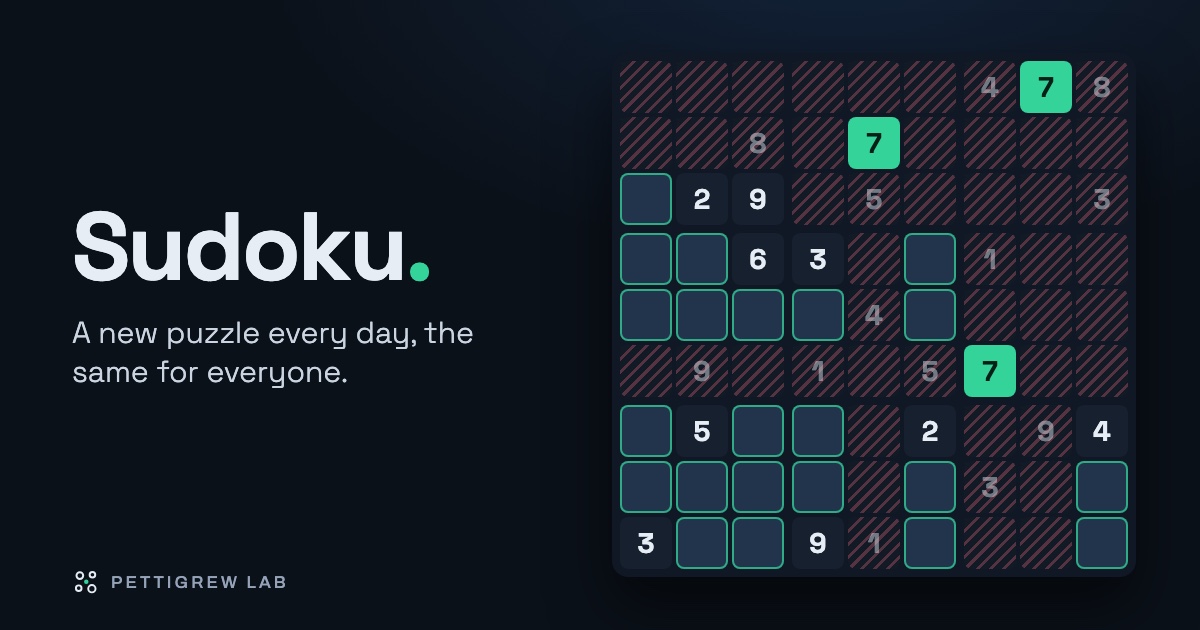 Daily sudokuA new puzzle every day, and everybody gets the same one. Easy through Expert, plus small boards for kids.Play today’s puzzle
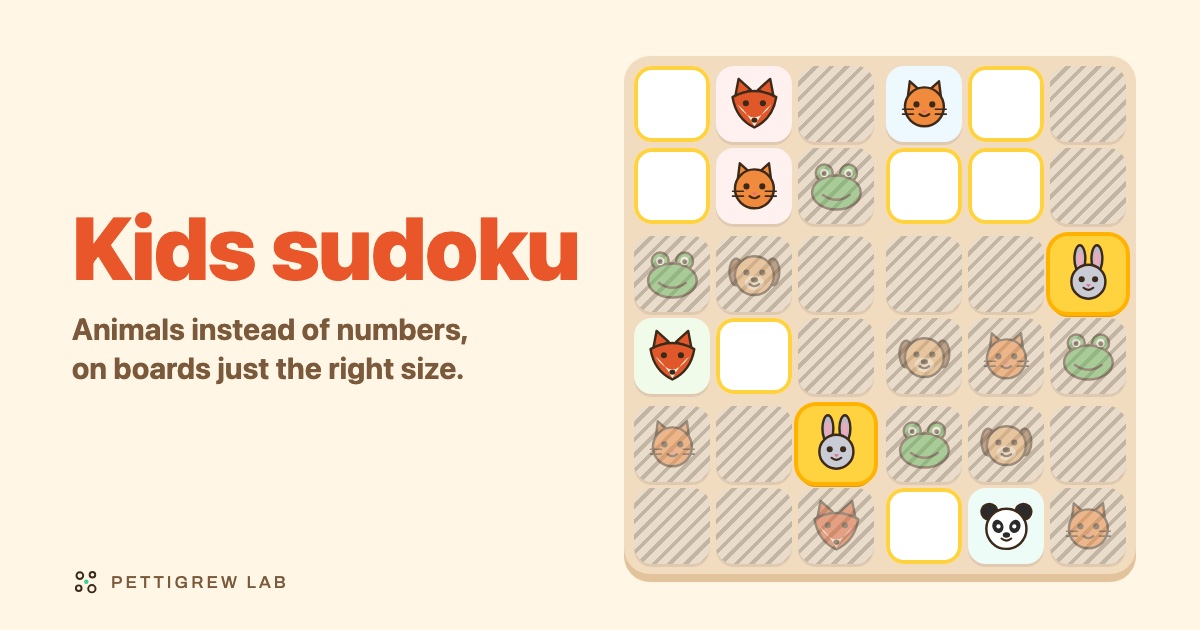 Sudoku for kidsSmaller 4x4 and 6x6 boards, with animals instead of numbers.Play with the animals
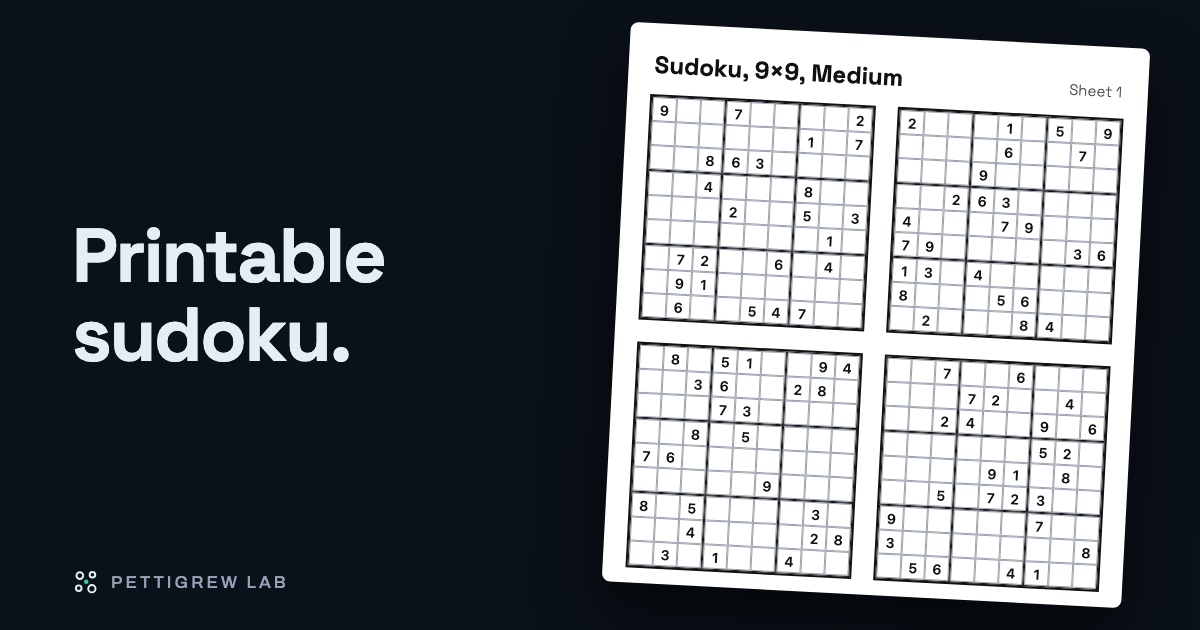 Printable sudokuFour to six puzzles on a page, with the answers on the next.Print a sheet
We make phone games too
See all our gamesWhen the puzzle’s done, here are a few of ours.
 POTUS KOA presidents game that makes U.S. history stick. Right answers train your fighter, what you learn about each president tells you how to beat them, and every win goes in your binder.See the game
 Silicon GateTower defense built from real circuits. Every tower is a real electronic part, and any two make a circuit.See the game
 Bond SwapA match-3 where the tiles are atoms. Swap them into real molecules, from water to chloroform.See the game